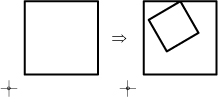
Kotsopoulos S, Ph.D. Dissertation, Massachusetts Institute of Technology, 2005
II. Shape Computation Theory
4.2 1. What is a shape rule ?
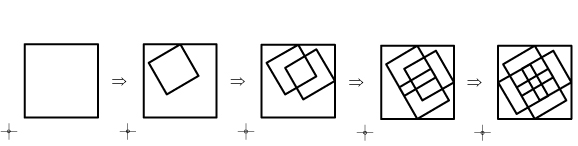
4.2 2. What is a derivation ?
A shape rule of the form a --> b, relates two shapes a, b in a particular way. In the example two shapes a, b made out of lines are manipulated on the plane, in the algebra U12, according to the following rule:
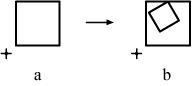
Each time the rule applies on shape C a new shape C' is produced. A concise way to express the productive
process is the next sequence of shapes, which is called derivation.