


Kotsopoulos S, Ph.D. Dissertation, Massachusetts Institute of Technology, 2005
II. Shape Computation Theory
4.2. SHAPE GRAMMAR
4.2 1. What is a shape rule ?
A shape rule is a production of the form a --> b, between two shapes a, b . The shapes need to belong to some
shape algebra Uij within which shape operations can be executed, and the transformations together with the
embedding relationship can be used. A shape rule is a computational device that allows the two shapes a, b to be
placed together (com-posed) in some desired way.
The next example, shows how two shapes are put together to form a particular relationship. The shapes a, b of
the example are made out of lines. They belong to the algebra U12 , which contains lines manipulated on the plane.
A shape rule of the general form a --> b applies to some initial shape C like the next, under some transformation t.


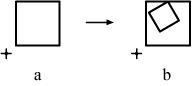
The rule a --> b applies on a shape C in two steps. First, some transformation t (in this case scaling) is used with
the part relation < to "match" some part of the given shape C to the shape a, which appears on the left side.
from C. And, the operation of shape addition (+) is used to add the same transformation t of the shape b, to C. The
shape b is the one that we see on the right side of the shape rule.

C' = [ C - t (a) ] + t (b)